
Blog
Articles, insights, and deep dives from the Arcanada team.

Datarim keeps the work, the checks and the result together
From the 4.3 series through 4.8.0, Datarim has made agent-assisted work easier to resume, check and share with a team.

Knowledge Contracts, Version 2: A Typed Substrate for Inter-Agent Knowledge Transfer, with Its Algebraic Laws Proved or Refuted
The second version of the Knowledge Contract work: the typed substrate implemented and mutation-tested, its algebraic laws proved or refuted on the carrier, and the empirical check version 1 declared missing — with the refutations as the headline result.
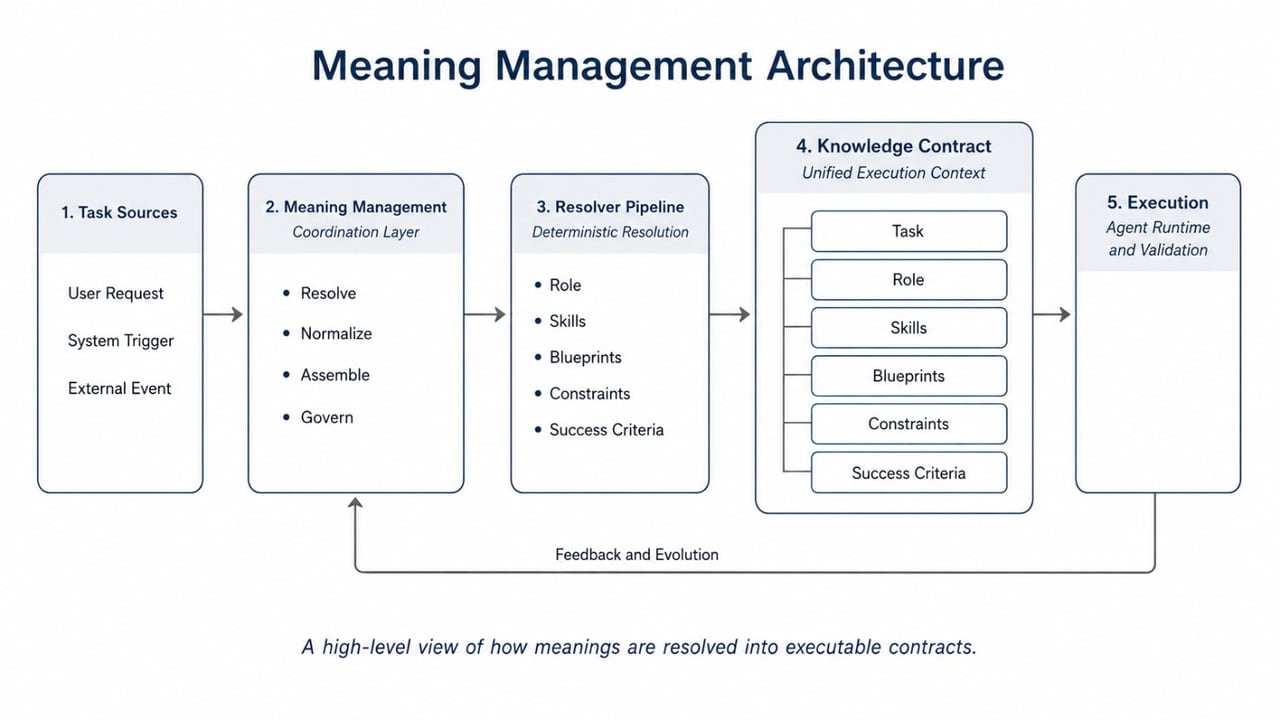
Meaning Management in Autonomous AI Systems: the Knowledge Contract Architecture
A conceptual architecture that separates available context, selected semantic commitments, the immutable Knowledge Contract, runtime binding, and the authorization of a particular action.

MCP vs CLI: Why I Think We Are Arguing at the Wrong Level of Abstraction
CLI and MCP do not have to compete: one is an execution mechanism, the other an integration mechanism, and the architecture should choose the best available capability path.

AI-First: From a Useful Idea to a Human Decision
Development, research, and the return to a complex project led me to one way of working: agents expand what is possible, while purpose, risk, and the final decision stay with a person.

Angry Robot: Returning to a Complex Project
With old code, data, strategies, and infrastructure to recover, returning to Angry Robot took too much time. Agents helped me recover the context and start moving the project forward again.

Conversation to Markdown: Long ChatGPT Chats and Images
The extension is now on the Chrome Web Store: long conversations export in full, images download next to the text, and files are named after the conversation. Version 1.1.8 drops the time limit entirely — tested on a chat of 800+ messages.

Cubrim: Let Measurement Settle It
In Cubrim, agents help me test more hypotheses. I keep a hypothesis when the file comes back byte for byte and the compression ratio goes down.

What Hundreds of Business Tasks Taught Me
In real work, I start with the result a user needs, give agents the current context, and ask someone else to check the change where people will use it.

Cubrim for B2B: Compression Economics at Scale
Where a general-purpose compression platform can reduce storage, backup, and data-transfer costs—and how Cubrim will prove that value on real enterprise workloads.