

Last night I fell asleep in a rough state.
With heavy thoughts about the future, with a terrible headache and toothache. I didn't know what the new morning would bring. I simply hoped for a miracle, said a prayer, and went to sleep.
And in the morning the miracle really happened.
The headache and toothache were gone as if by magic. For that, my deepest thanks to my wife Victoria and my dentist Alina — to her golden hands, her attention, and her sincere concern for my health.
But this morning gave me one more miracle. On an entirely different scale.
Cubrim has finally reached the top of the world data-compression benchmarks.
For me this is not just a piece of technical news. It's a story that began many years ago.
An idea that gripped me back in my student years
Even as a student, I was obsessed with the idea that I could solve one of the fundamental practical algorithmic problems — the problem of data compression.
There are a few directions you could call the basic pillars of applied algorithms: searching data, sorting data, and compressing data.
Search and sorting seemed to me back then too large, too mature, and too far from where I felt my own strength. Compression, on the other hand, simply captivated me. It always seemed to me that humanity had not yet fully explored this field. That somewhere out there, beyond the existing algorithms, there were other approaches. Stronger, more beautiful, more universal.
I thought about it day and night.
Sometimes I would wake up in the middle of the night with yet another "brilliant" idea, quickly write it down, and then, once I tried to implement it on a computer, realize that I had reinvented the wheel. Or simply come up with a bad algorithm. Or an idea that sounds beautiful in your head but falls apart at the first contact with real data.
But I kept going.
After many months of such experiments, I arrived at ideas I could no longer fully make sense of. I'll be honest: it was very hard. Yes, I have a mathematical background, but even that wasn't enough. And back then there were no computing resources, no tools, and no helpers that could test my hypotheses in any reasonable amount of time.
So I set those ideas aside, "for later."
Years passed.
And that "later" has finally arrived
Artificial intelligence agents came to us. And for researchers who carry complex ideas in their heads for years, this is a genuine salvation.
Because now, beside you, there is not just a tool that executes commands. There are helpers that can implement hypotheses, test variants, hunt for errors, suggest different moves, argue with you, improve the code, run experiments, and do the things that a single person simply didn't have enough of a lifetime to do.
That is how my new product in the Arcanada ecosystem came to be.
It is called Cubrim. In Russian — Кубрим.
Cubrim is a local data archiver. The first thing I implemented in it was my old idea in the field of archiving. And it worked. It really did produce a compression result.
But to understand how good that result actually was, I had to do far more than just write the algorithm.
I had to figure out how archivers are compared in the world today. What benchmarks exist. How the test datasets are built. Which metrics are considered important. Where "seems good" ends and an honest comparison with the world's leaders begins.
I found three leading benchmarks to aim for. I reproduced them on my powerful dedicated server and started running Cubrim on that data.
The real research work
That is where the real research work began.
I optimized the algorithm. I changed the approaches to storing the unfolding matrices. I reconsidered the data analysis. I looked for new ways of processing. I tested hypotheses one after another.
Gradually the positions started to improve.
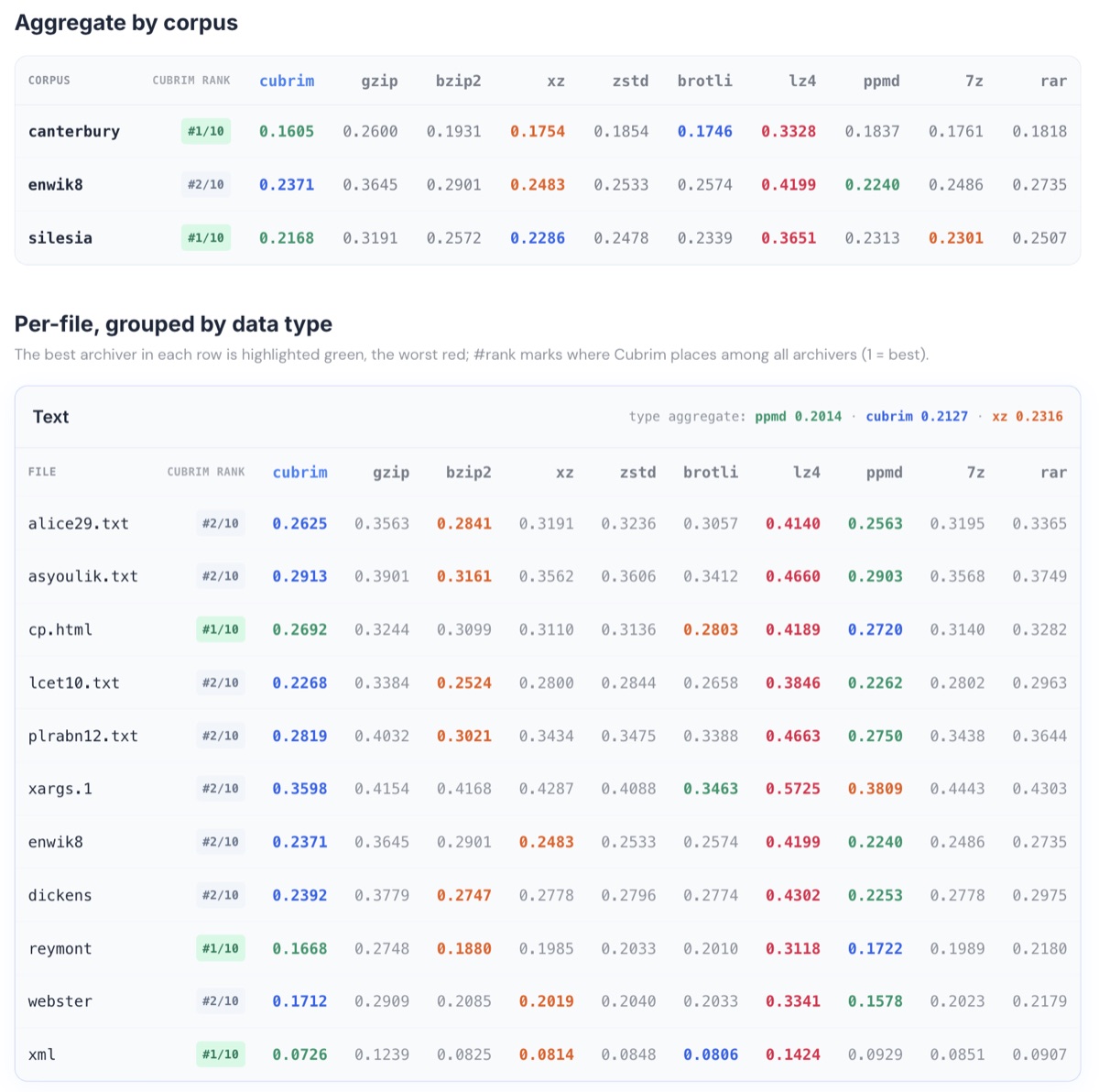
At first Cubrim was in tenth place. Then ninth. Then eighth. Then seventh.
Step by step it began to catch up with and overtake the leaders.
In parallel, dozens of agents were working, exploring my hypotheses. By now there are already more than eighty such hypotheses. Most of them are published on the site. There you can also see the whole progress of the archiver's development, the results of the experiments, and Cubrim's movement across the world benchmarks.
And today that very miracle happened
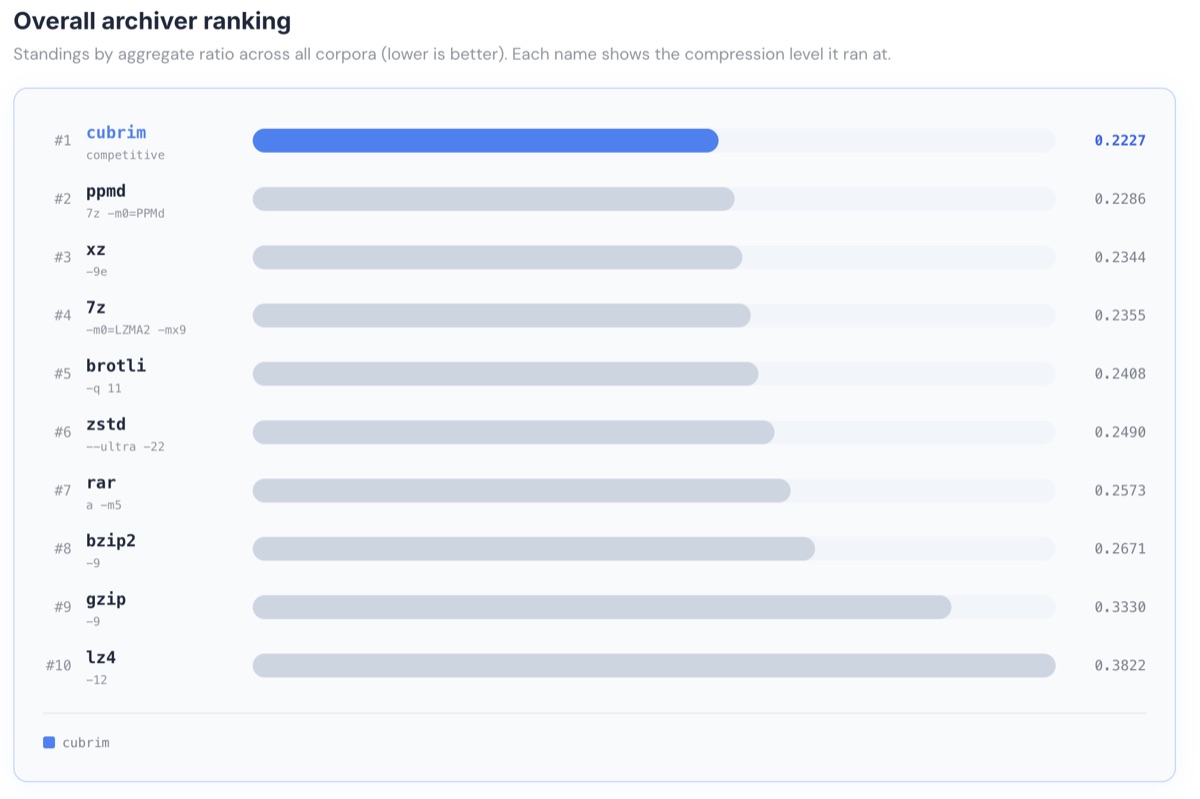
The accumulated hypotheses, which required a long time to compute, were finally completed. A fresh benchmark ranking was published.
And it turned out that Cubrim already holds the top spots in several key comparisons. In one benchmark it reached first place. In others — second. And across most of the individual data types, Cubrim sits in first or second place.
For me this is a very powerful moment.
Of course, there is still a lot of work ahead. I can see where the result can be improved. I want to reach first place on every meaningful metric. I want to make the archiver not only strong, but also fast, stable, convenient, industrial.
But even the current result already matters a great deal.
Because it proves one simple thing to me: artificial intelligence agents are needed not only to quickly assemble yet another MVP or Proof of Concept.
With their help you can realize old dreams.
Those ideas that lay for years in your head, in notebooks, in old files, in unfinished projects. Those research directions that once seemed too complex for a single person. Those tasks that required a team, a budget, time, servers, patience, and dozens of attempts.
Now this is becoming possible.
Why Cubrim matters to me at all
I need my own data medium for Arcanada. There will be too much data inside the ecosystem. It will be stored in a distributed way, across different servers, in different environments, in different formats. I need an archiver that will belong to this ecosystem. Ideally — fast, strong, and independent.
I did not start Cubrim with the idea of "beating everyone." It was enough for me to create my own algorithm that really compresses data and for which you don't have to pay someone else's license.
Cubrim will be free for private users. Soon I plan to make it available for download on the site. For commercial use there will be a separate license — roughly in the range of 30–50 dollars per year per workstation.
But right now, even that is not the main goal.
The main idea of Cubrim is far broader
That very idea I came up with back in my student years concerns not just a local archiver. It concerns global data compression, global data addressing, and the transmission of enormous volumes of information across enormous distances.
Including — across cosmic distances.
Or under conditions of critically poor radio communication.
We are developing this project together with my daughter Ekaterina. She is an aerospace engineer, and for me that is especially precious. Because Cubrim is gradually turning not just into an archiver, but into a research project about the future of storing, transmitting, and addressing data.
The second article of the series will be devoted to this theme.
In it I will tell you about the Global Addresser and the Valentov Universal Data Tables — about the part of Cubrim where it stops being simply file compression and becomes an attempt to look in a new way at data transmission in a world where distances, communication channels, and volumes of information are becoming critical constraints.
And the third article will be devoted to the more applied side: the algorithms of Cubrim, the market for archivers, and how such technologies can be monetized in the modern world at all.
But today I simply want to share my joy
Dreams really do come true sometimes.
Not always quickly. Not always the way we expect. Sometimes they need to lie in your head for many years, to wait for the right time, the right tools, the right people, and the right pain.
But if an idea is alive — it comes back.
And today, for me, Cubrim has become exactly such a return.
Thank you for following my news.