
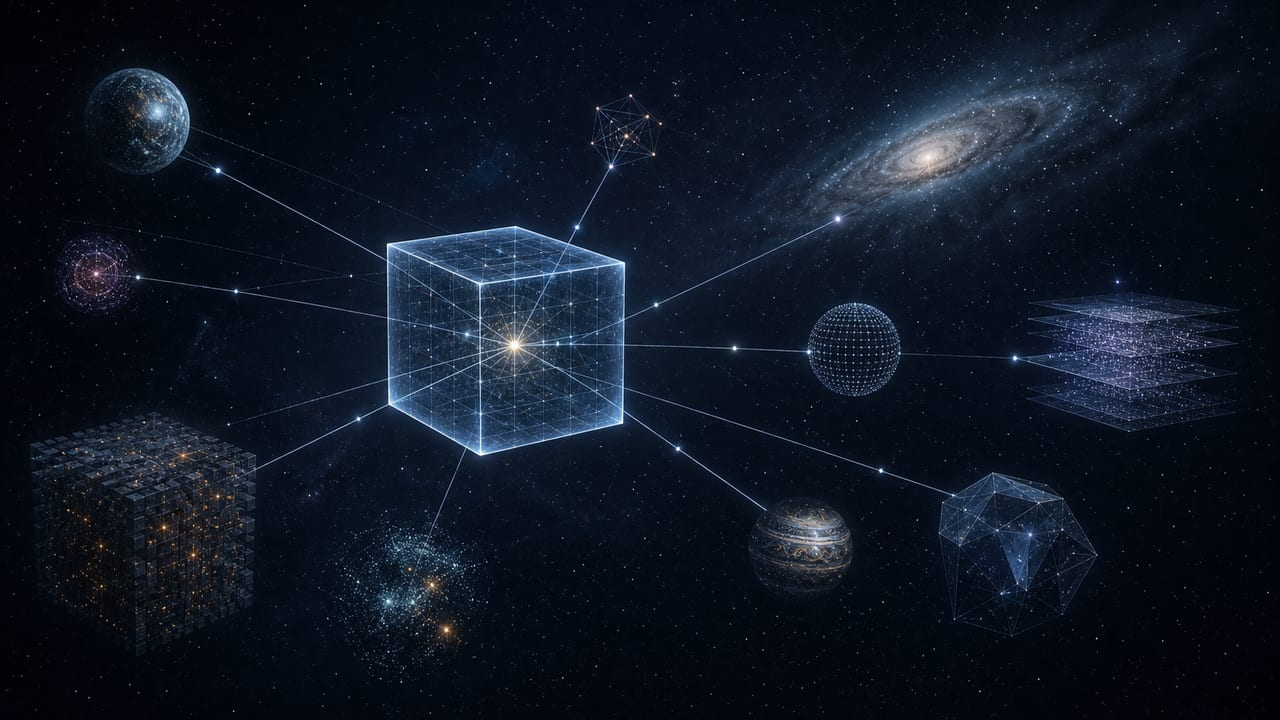
Cubrim-1 and Cubrim-2 are not two versions of the same result. Cubrim-1 already works as an archiver: it can be run, its files can be reconstructed, and its output can be compared with other programs. Cubrim-2 is my Global Addresser research. It asks a different question: if devices receive the same verified memory in advance, can they exchange references to familiar blocks and send only the data that are genuinely new?
That boundary matters from the first paragraph. One result has been measured. The other is not yet a product, and it is not a promise of miraculous compression. It is an engineering hypothesis with a physical cost: catalogs, versions, distribution, and cases in which it must lose.
First, what has actually been measured
In the open benchmark across the Silesia, enwik8, and Canterbury corpora, Cubrim-1 ranks first by the overall weighted result among ten archivers. Its ratio is 0.2227. The nearest competitor is PPMd at 0.2286, about 2.6% higher, where lower is better. xz, 7-Zip, and Brotli follow.
This is a precise claim about one benchmark and its aggregate metric. Cubrim does not win every file, and first place does not make it universally superior. What matters more to me is that an idea which spent years in formulas and experiments became a byte-exact program whose result can sit in the same table as established tools.
Cubrim-2 does not inherit that ranking. The Addresser has a different job and a different standard of honesty: the relevant measure is not the elegance of a short reference, but the full cost of the shared system.
From an archive to shared memory
A conventional archive brings the receiver everything required to reconstruct a file. An addresser begins from another condition: sender and receiver already hold the same catalog of immutable blocks. A familiar fragment can then be named by an address, its assembly order can be described, and the channel can carry only the missing residual.
There is no magic in that transaction. A short address works because the data already exist somewhere. If a required block is absent, a reference cannot create it. If catalog versions diverge, reconstruction may be wrong. If an object is unique, the object itself still has to travel, with metadata added on top.
An honest accounting therefore includes the addresses, catalog, metadata, unique residual, storage, and distribution of the shared foundation. The gain exists only in repetition, and only when the cost of that foundation is amortized across files and devices.
Matrices: limits on paper and data on disks
Our working name for the shared foundation is the Valentov Universal Data Matrices. “Matrix” describes how bits are arranged; it does not repeal combinatorics. A B-bit block has exactly 2B possible values. Dimensionality does not change that count: a one-dimensional 64-bit string and a 4×4×4 cube both contain 64 bits and have the same 264 possible states.
Imagine a store of 20,000 one-terabyte disks and try to keep every possible value together with its contents. B=51 is the last size that fits: 251 × 51 bits is 1.44×1016 bytes. B=52 already requires 2.93×1016 bytes. Around B=266, the count 2266 reaches roughly 1080, comparable to the familiar estimate for atoms in the observable universe. Enumerating all matrices is physically meaningless. A real system can store only blocks that have actually occurred.
I tested that practical case on a 13.48 GB cross-device corpus: 9.06 GB from the ecosystem's development host, 3.38 GB from the ecosystem's public web host, and 1.04 GB from the ecosystem's production host. Only hashes crossed between hosts. The same 4,096 bits, or 512 bytes, were arranged in four layouts:
- 1D: 14,965,607 unique blocks, 57.80%, occupying 7.14 GiB;
- 2D: 12,077,059, 62.35%, occupying 5.76 GiB;
- 3D: 8,020,728, 57.46%, occupying 3.82 GiB;
- 4D: 5,578,363, 53.03%, occupying 2.66 GiB.
The 4D layout produced the fewest unique blocks in this test. That does not prove a universally optimal dimensionality: the layouts need different alignment and cover slightly different portions of the corpus. The more important observation is that there was no saturation. The unique-block count kept growing almost linearly to the end of the scan.
If I mechanically extend the measured unique share to a world data volume on the order of 10 ZB, the matrices occupy about 5.3–6.2 ZB — billions of one-terabyte disks. This is a linear extrapolation, not a forecast: the global corpus has a different composition, and behaviour may change at larger scale. Still, it is a useful corrective. The Addresser's opportunity is not a warehouse of “every possible cube.” It lies in deduplicating the repeated 38–47% and in curation: retaining blocks seen at least twice instead of accumulating everything.
A short address does not erase the cost
The research found an amortization threshold of N*=2 across all seven measured data classes: where repetition between devices genuinely exists, a second device can already repay the catalog and reference overhead. For strictly unique personal data, however, repetition approaches zero and N* tends to infinity. There is no shared saving there.
This is a fundamental limit, not a defect waiting for a clever implementation. An address needs a catalog. A catalog needs storage, synchronization, and confidence in block identity. Private data cannot automatically become a common dictionary merely because that would improve the arithmetic.
I therefore make no claim that “any file becomes a few bytes.” I am looking for the region where a pre-positioned, curated foundation really costs less than retransmission, while marking the region where conventional local compression remains the more honest and effective choice.
Why space makes the question practical
Space turns an abstract saving in bytes into mission architecture. A spacecraft has finite memory and energy. Contact windows have schedules. A retry may cost hours or days. Meanwhile, the vehicle must survive an interrupted channel, verify every block, and recover a working state without a person beside it.
This is where I work with my daughter Ekaterina, an aerospace engineer and coauthor of the idea. I can become absorbed in an elegant representation; she asks the spacecraft's questions. Which block version was loaded before launch? How much energy does an update consume? What remains after a partial pass? Can the system roll back to an intact version? What must it do autonomously when one fragment fails verification?
Those questions produce falsifiable scenarios. Suppose Earth and the spacecraft begin with the same base map. A later contact window carries new observations, a list of addresses, and a version manifest. The experiment succeeds not when the packet is small, but when the vehicle survives an induced interruption, identifies a missing block, refuses to mix versions, reconstructs the complete object, and retains the previous valid assembly. If nearly the whole object must be resent, the Addresser did not win that scenario.
Another scenario is a fleet sharing a software foundation while carrying different instruments. Here the experiment must charge more than one Earth-to-space link: it must include distribution of the foundation, onboard storage, and every later update. That accounting separates useful amortization from a cost merely moved into an invisible column.
Research, not a promise
The Addresser's deep-research phase completed twenty-four hypotheses and led to a scoped, two-mechanism architecture for a prototype. This is no longer pure speculation: there are measurements, negative results, and operating boundaries. It is not yet a universal product. I keep the complete hypothesis log, methods, and current development status in the live Global Addresser section on cubrim.com, so that this article does not replace a research record with a polished retelling.
What I value most in working with Ekaterina is the ability to disprove our own design. A space scenario must state the matrix version, onboard memory, energy budget, contact window, acceptable delay, and recovery procedure in advance. Then we can cut the channel at the worst moment, corrupt a block, change the catalog, and see whether the system still completes the mission. If it does not, that is not “almost a success.” It is an exact location for the next engineering decision — or for an honest refusal.
I still want Earth and a distant spacecraft to share a language for data. I now like the metaphor precisely because it is not magical. A language must be learned in advance, its dictionary delivered, its versions agreed, and its errors detected. Cubrim-1 showed me that a long-held idea can become a measurable archiver. Cubrim-2 must earn its next step in the same way: through reproducible tests, not promises.