
Claude Code has a problem you'll only discover after 20-30 sessions: its memory degrades.
Auto Memory: How It Works
Auto Memory landed in v2.1.59 (March 2026). Claude writes notes about your project: build commands, architecture decisions, preferences, debugging patterns. Everything lives in markdown files at ~/.claude/projects/your-project/memory/. The index file MEMORY.md loads into every new session (first 200 lines or 25KB).
Sounds great. In practice, after 20+ sessions memory turns into chaos: duplicate entries, stale facts ("API uses Express" when you migrated to Fastify weeks ago), relative dates, references to deleted files. Up to 30% of entries become garbage.
Auto Dream: The Fix That Shipped Broken
Auto Dream is what Anthropic quietly shipped in v2.1.81. A background sub-agent that consolidates memory between sessions. Four phases:
- Orient — reads current memory directory structure
- Gather signal — searches session transcripts for corrections, decisions, patterns
- Consolidate — merge data, convert relative dates to absolute, remove contradictions
- Index — rebuild MEMORY.md, keep under 200 lines
Trigger: 24 hours + 5 sessions since last consolidation. Takes 8-10 minutes. Writes only to memory files, never touches source code.
The naming references REM sleep on purpose. It's memory consolidation during "downtime."
The Bug
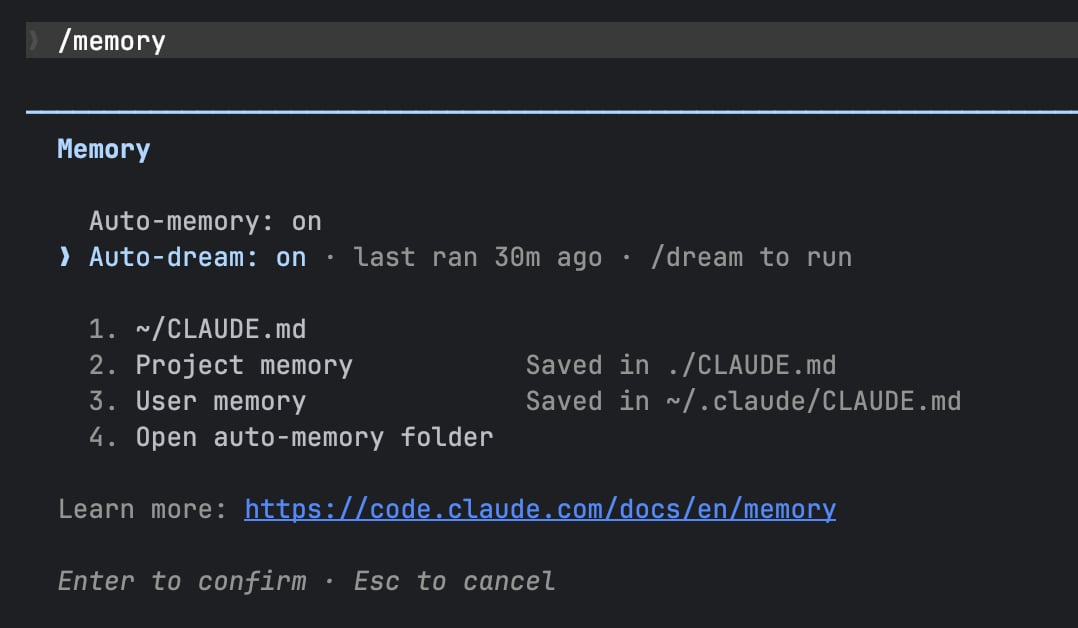
The /memory UI shows: "Auto-dream: on — last ran 13h ago — /dream to run". Type /dream — you get Unknown skill: dream.
This bug (GitHub Issue #38461) has been open since March 24, 2026. Reproducible from v2.1.81 through v2.1.92+. Zero response from Anthropic. The feature isn't documented in official docs at all.
There are also related issues: #38426 and #39135, all reporting the same disconnect between UI and actual functionality.
How to Configure (What Actually Works)
Check your version: claude --version (need 2.1.59+). Open /memory and verify Auto memory is on.
In settings.json:
{
  "autoMemoryEnabled": true,
  "autoDreamEnabled": true
}
Disable via env: CLAUDE_CODE_DISABLE_AUTO_MEMORY=1
Workaround for /dream: just tell Claude in chat: "dream" or "consolidate my memory files". It runs the 4-phase consolidation manually. Tested and confirmed.
Should Other Agent Systems Implement This?
Absolutely. Memory decay isn't a Claude Code problem. It hits any stateful agent. If your agent accumulates context across sessions, after 50 iterations you'll have a pile of contradictions. Memory consolidation isn't a nice-to-have, it's a requirement.
But Anthropic's rollout shows what NOT to do: UI promises a feature that doesn't work; changelog says nothing; docs are silent. If you're building your own, either ship without UI promises, or finish the job.
For your own systems: the 4-phase architecture (orient, gather, consolidate, prune) is a good template. Key rule: the consolidator writes ONLY to memory files, never to project code. Lock files for concurrency. And log what changed — Auto Dream has issues with that too (Issue #38493).