

Voice is easy to turn into text. The harder part is making sure the result does not get lost among files and can still take part in the next step of the work: a meeting transcript, subtitles, search material, or input for another product.
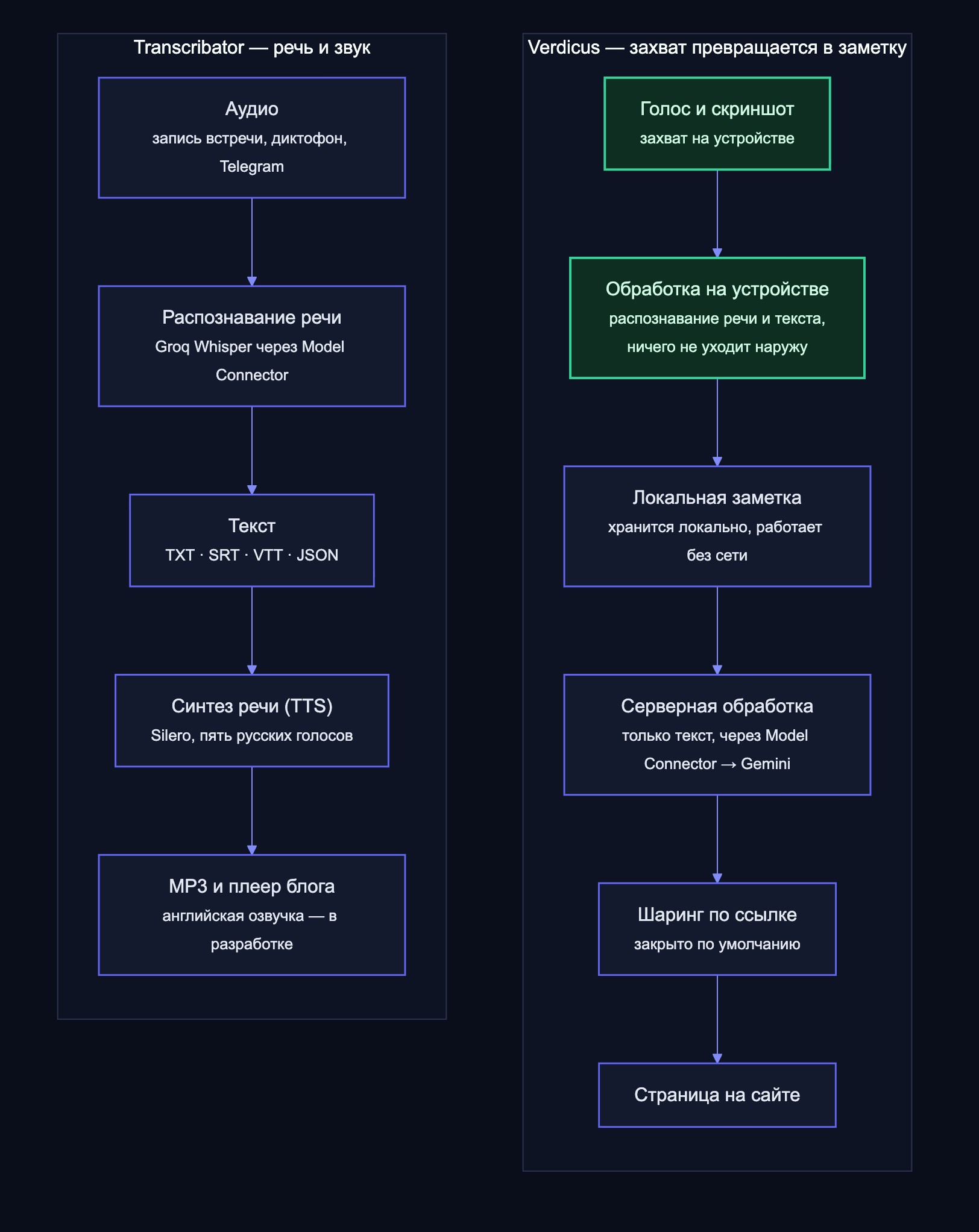
Two products carry that chain in the ecosystem. Transcribator processes audio and turns it into text. Verdicus works with captured context and turns it into a note. Today these are separate tools; shared context between them is still the next step, not a live integration.
Transcribator: from speech recognition to speech synthesis
Transcribator lives at transcribator.com. Its job is to turn an audio recording into material that is easy to use later. The production layer now covers speech recognition: Groq Whisper through Model Connector, with a direct Groq fallback on 5xx, 413, or timeout.
The transcription output comes in TXT, SRT, VTT, and JSON. Plain text is easy to read, subtitles preserve time marks, and JSON keeps structure for later automated processing.
This is no longer only speech recognition. Transcribator now has speech synthesis in production: Silero RU with five voices, which adds another real output path instead of replacing the transcript itself.
For recordings with several participants, words are not the only useful part. The structure matters too: where each turn starts, which time it belongs to, and how the material can become a protocol or subtitles. On the factual side, there are segments with time marks and speaker labeling where that mode is enabled; automatic assignment of real names is still not a finished capability.
The architectural role of Transcribator is broader than an ordinary voice recorder. The results are immediately available in formats and structure that work for the next step. But meaning does not appear at the moment of recognition. It comes from later processing, search, and context. That is why speech synthesis in this article matters not as decoration, but as a new production extension of the chain.
The nearest Transcribator tasks are about web-service quality and the processing pipeline: stable transcription, correct export formats, predictable work on long recordings, and bringing the synthesis branch into everyday use.
English voice track and recursion
The English channel for speech synthesis already exists, but quality is still unvalidated. That makes this a real roadmap: the search for a free CPU engine for English narration is ongoing, rather than a claim of finished quality.
Recursion works better here than any marketing line: this article is also narrated by Transcribator. It should have a player under it, not a placeholder, because the product already turns text into narration and returns it in blog-friendly form.
Verdicus: capture turns into notes
Verdicus is the app at verdicus.app, a macOS assistant for capturing context. It collects voice and screenshots on device, turns them into a local note, and sends neither audio nor pixels outside. This is an on-device layer with no data leakage outward.
The note can then go through optional server processing via Model Connector → Gemini, but only the text goes there. After that, sharing by link is available, and it stays closed by default: closed access first, publication by token later. That chain makes Verdicus more than an assistant for selected text; it becomes a product where capture turns into notes.
Verdicus also has a separate product path: a prepared route to the App Store. That is the continuation of the route, not a finished fact. Publication remains in the roadmap because stable debugging and a reproducible release come first.
Bridge between the products
The link between Transcribator and Verdicus is naturally a shared context: audio and screenshots can be turned into notes, and notes can serve as input for the next step. But that bridge is still a roadmap item, not a live product connection.
That is why there is no need for a polished claim that a shared knowledge base already works. The point is different: the foundation for common context is clear, but its honest status is still just a direction of development.
Direction for month three
The direction for month three of Arcanada is to bring several ecosystem products into the app stores. That is an aspiration, not a finished fact. For Verdicus, that means continuing the already prepared path to the App Store; Transcribator is not promised for app stores.
Before publication, there is still quieter work to close: release builds, updates, support, and a reproducible path from a fix to a new version. That layer is already described in the article on the move from virtual machines to bare metal.
The goal is to reduce manual work around every incident: an incoming issue should become a task, a fix should pass checks, and a release should stay controlled. The mechanics of that autonomy and its gates are already covered in Releasing the Reins; here the next step is to apply that system to product releases.
The big picture of month two already showed how ecosystem growth turns into stronger foundations. And Context Decides together with Releasing the Reins explain why the next step should be built on the products' shared logic, not on isolated gestures.
Product development can be followed at transcribator.com and verdicus.app. Public release will come only after installation, updates, and support become as much a part of the product as its core features.