
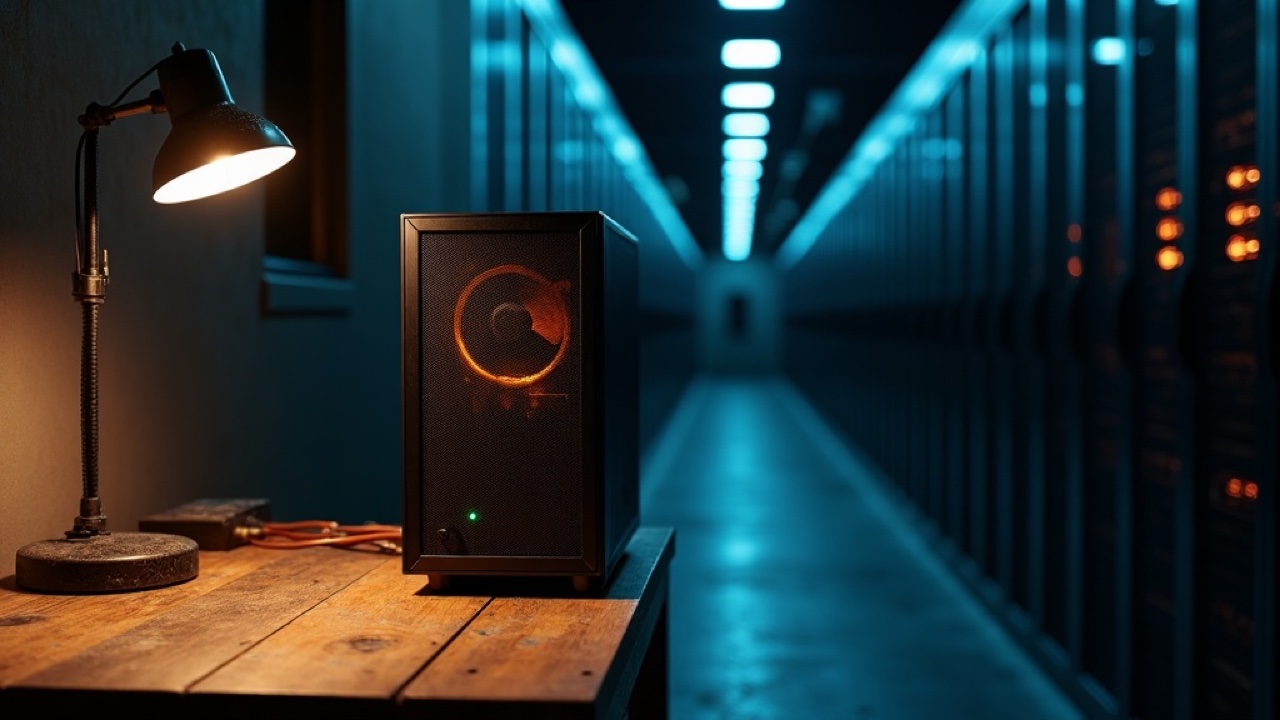
Announcing an intent to compete with Dropbox and Google Disk usually meets polite skepticism — and fairly so. File synchronization is one of the most competitive corners of software: giants with billion-dollar budgets, protocols refined over decades, engineering teams in the thousands. On the other side — a Claude subscription, a fleet of personal servers, and a handful of agent-coworkers.
Entering this market still makes sense — not out of overconfidence or underestimating the risks, but from a specific theory: it can be won through a model the giants cannot copy even if they wanted to. The model is the economics of ownership.
A Red Ocean
File synchronization is a classic "red ocean." Dropbox, Google Disk, OneDrive, iCloud, Yandex.Disk all solve the same task: sync files between a server and nodes — computers, phones, tablets. The differences are mostly ecosystem, integrations, and price.
The user experience has barely changed in twenty years: install the app, pick a folder, files sync. Competition runs on price per gigabyte, sync speed, and reliability. The giants cannot cut prices radically — their model rests on subscription margins: infrastructure and engineering salaries have to be earned back.
But offer the same functionality on a model where the cost base approaches zero, and undercutting any of them becomes possible.
What Disk Arcana Is
Disk Arcana is an application for syncing files between a server and devices. At the bottom sits a Rust core with a gRPC protocol and delta synchronization: only changes travel across the wire, not whole files. Above it — per-OS bindings and an Obsidian plugin, because syncing a knowledge base is one of the core use cases. Desktop (Linux, macOS) comes first; Windows and mobile clients (iOS, Android) are the next, already commercial stage.
The starting point is simple. A personal knowledge base in Obsidian, notes syncing between a laptop and a phone — and every time the same question: why pay to sync your own files over your own infrastructure? The files are yours, the hardware doing the sync is yours. The fee is the odd part out — and that question is exactly where Disk Arcana began.
Two Models — One Protocol
Disk Arcana has two usage models — not a marketing trick, but an honest architecture.
Model one: your own server. Any spare hardware — an old laptop, a Raspberry Pi, a cheap cloud VPS, a home NAS — runs the Disk Arcana server side. It is fully free and open, under the MIT license. Syncing files across devices then costs nothing beyond the price of the hardware itself. The data owner is the user: where it lives, who has access, how often backups run — their call. No hidden analysis of files to train models, no parsing of content for ads.
Model two: someone else's server. When there's no desire to run your own server, no spare hardware, or a need for reliability that's hard to guarantee at home — the connection goes to Arcanada's servers for a small fee. Exact figures aren't named yet, but the fee will be lower than Dropbox or Google Disk: the operating model allows it.
The key architectural detail: both models run the same protocol and the same sync code. The only difference is who holds the server. No "corporate tier with full sync" versus a "stripped-down free one" — everything is identical.
Why the Giants Can't Do This
Dropbox and Google Disk have no "bring your own server" option — and not because they didn't think of it. It breaks their business model: if syncing on your own hardware is free, there's nothing left to pay for, and shareholders won't approve.
They can ship an open-source client (attempts have been made). They can offer an API (many do). But the option "take our code and run it yourself without our server" is impossible for a public company with a billion-dollar valuation: it cannibalizes its own product.
Arcanada has no such problem — no shareholders to show high margins to. The goal is an ecosystem where user data is not the product. If that requires making the infrastructure layer free, it will be free.
This is the main difference between Disk Arcana and the ecosystem's two other products. Verdicus and Transcribator are headed to app stores as ordinary paid programs (the approach to products is covered in a separate article in the series). Disk Arcana works the opposite way: open code, free on your own server, a fee only for the convenience of someone else's. These are deliberately different models for different tasks, not one business in three wrappers.
The Economics of Ownership
Competing with Dropbox head-on is pointless — they're faster, more reliable, with decades of development behind them. Competing on the economics of ownership is not.
When every user runs their own server, the cost of supporting millions of user servers disappears — the infrastructure load drops by orders of magnitude. Only the servers for those who chose not to self-host need maintaining. The same logic as moving the ecosystem from virtual machines to its own hardware: owning the equipment removes the standing rent. Undercutting becomes possible because the model doesn't require a margin.
More than two dozen tasks are allocated to Disk Arcana for the near-term development window. The Rust core is already written — it grew out of an earlier storage-synchronization project. The gRPC schemas are designed. What remains is gluing together the GUI layer on each platform, the Obsidian plugin, a server-deployment utility, and the documentation. It's achievable.
Your Own Server Is Freedom
The image of Disk Arcana echoes the metaphor of letting go of the reins: there it was about control over code and processes, here it's about control over data.
Terabytes of notes, projects, family photos, and archives sitting on a server owned by someone else is not data ownership — it's renting space along with trust in a privacy policy that can change at any moment. On your own hardware, the rules of encryption, backups, and access are set by the owner — it's their territory.
A server of one's own isn't simple; it takes technical literacy. But for those ready for it, it's an honest choice, and that choice should exist. Most people don't need it: paying and not thinking is easier — and the second model is there for them. The point isn't to convert everyone to self-hosting, but to remove a wall the giants don't have even on the roadmap: the very possibility of walking away from rent. That possibility alone changes the conversation. As long as a free alternative exists on your own hardware, the paid version has to stay honest on price — otherwise the user simply leaves for their own server. Competing with one's own free option keeps the paid model in shape better than any marketing department.
The Right to Choose
Arcanada is being built not as "just another startup" but as infrastructure to build something of your own on. Disk Arcana is one of its bricks. It won't bring billions, but it gives something more valuable: the right to choose — where files live, whether to pay for sync, whether to trust a corporation or your own hardware.
This isn't a "Dropbox killer," but a tool that makes owning your own data realistic for an ordinary user.